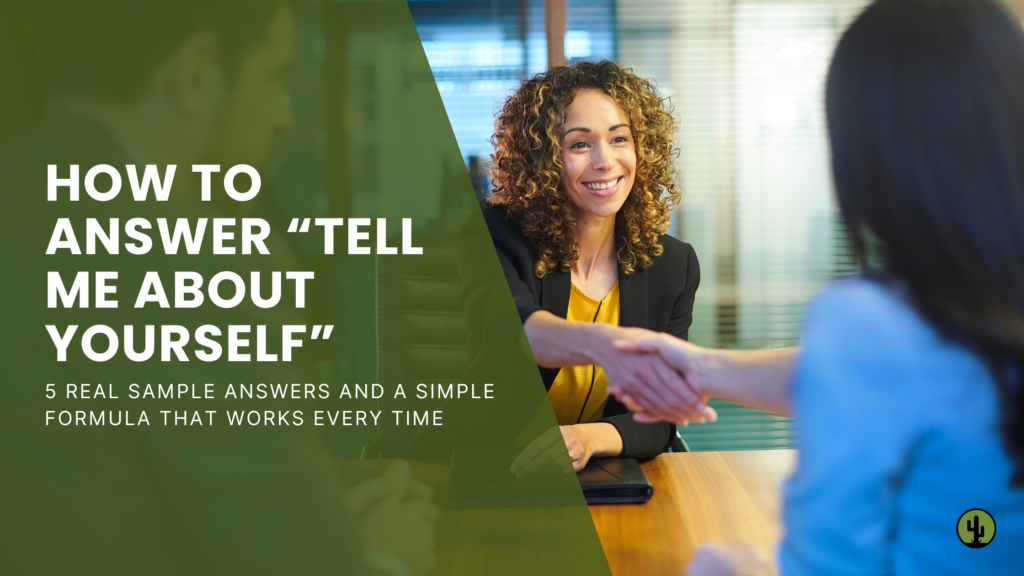
“Tell me about yourself.”
Four simple words. And somehow, one of the most difficult questions to answer in any job interview.
You know yourself better than anyone. So why does this question trip so many people up the moment you are sitting across from an interviewer?
Because it is not really asking you to talk about yourself. It is asking you to sell yourself, clearly, confidently, and in under two minutes.
In this guide, we’ll show you exactly how to answer “Tell me about yourself” ” in a way that makes a strong first impression, whatever your background or experience level.
You will learn exactly why interviewers ask this question, how to structure a strong answer, what to avoid, and how to tailor your response depending on where you are in your career.
Why Do Interviewers Ask “Tell Me About Yourself”?
When an interviewer asks you to tell them about yourself, it is more than just your job history, they are trying to understand several things at once:
- How clearly can you communicate?
- Do you know what is most relevant about your background for this role?
- Whether you are confident and prepared
- How well your experience fits the role
This is usually the first question in an interview. A strong answer to “tell me about yourself” sets the tone for everything that follows.
You may also hear it phrased as:
- “Walk me through your background”
- “Take me through your CV”
- “Tell me a bit about your experience so far”
- “Tell me why you want to work in care”
- “How would you describe yourself professionally”
All of these are asking for the same thing. One strong answer will work for every version.
How to Build a Strong Answer to “Tell Me About Yourself”
A strong answer to “tell me about yourself” has three qualities:
It is relevant. Focus on what matters most for this specific role, not everything you have ever done.
It is structured. Many candidates use the Present → Past → Future format. A clear structure makes you easier to remember.
It ends with a reason. Always finish by explaining why you are interested in this opportunity. That is what separates a good answer from a great one.
Here is how the Present → Past → Future format works in practice:
Present: Where you are now.
Start with your current role, course, or most recent experience.
Past: How you got here.
A sentence or two on your background. Not your full career history, just enough context to help the interviewer understand your journey.
Future: Where you are going.
End by connecting your experience to the role you are applying for, why you are interested in this opportunity. That is what separates a good answer from a great one. This is the most important part.
Aim for 60 to 90 seconds. That is enough time to give a clear picture without losing their attention. Clear, focused, and confident.
What Not to Say
Knowing what to avoid is just as important as knowing what to include.
Do not give your full life story. The interviewer does not need to know where you grew up, what school you went to, or every job you have ever had. Keep it focused and relevant to the role.
Do not say anything negative about a previous employer. Even if your last job was difficult, this is not the time to mention it. Focus on where you are going, not what you are leaving behind.
Do not just read from your CV. The interviewer already has your CV. This is your chance to bring it to life and add context, not repeat it word for word.
Do not go on too long. More than two minutes is too long. If you are still talking after 90 seconds, wrap it up. You can always go into more detail in later questions.
Do not say you have no experience. Volunteering, placements, caring for a family member, and part-time work all count. Think carefully before you say you have nothing to offer.
How to Tailor “Tell Me About Yourself” to Your Situation
Everyone’s background is different. Here are five sample answers you can adapt to match your own experience. Each one follows the Present → Past → Future format.
If You Are a Care Worker Applying for a New or Senior Role
Example:
“I have been working as a care worker for three years, supporting adults with complex needs in a residential setting. I manage personal care, medication support, and daily record keeping for up to 12 service users. More recently I have been informally mentoring newer team members, which I have really enjoyed. I am now looking to move into a senior care role where I can take on that responsibility more formally.”
Why this works: It is specific about the type of care experience, mentions a number to show the scale of the work, and ends with a clear reason for applying that makes sense given the background.
If You Are Applying for the Access to HE Diploma in Nursing
Example:
“I have spent two years working as a healthcare assistant, supporting patients and working closely alongside the nursing team. That experience made me certain that nursing is the career I want to build. I do not have A-levels so I researched alternative routes and found the Access to HE Diploma in Nursing. I am applying because I want to gain the qualification I need to get into university and train as a registered nurse.”
Why this works: It explains the motivation naturally, addresses the no A-levels situation without apologising for it, and shows the person has done their research on the route into nursing.
If You Are Changing Careers and Moving Into Care
Example:
“My background is in retail management where I led a team of eight for five years. Over time I realised the part of my job I found most meaningful was supporting people through difficult situations. That led me to start thinking seriously about a career in care. I have completed my Care Certificate and have been volunteering at a local day centre. I am now ready to move into a paid care role and build on that experience.”
Why this works: It does not dismiss the previous career. It frames it as a source of transferable skills and shows the person has already taken practical steps toward the change, which makes the application feel credible.
If You Are a Recent Graduate With Little Work Experience
Example:
“I recently completed my Level 3 qualification and gained hands-on experience through placements and part-time work alongside my studies. I enjoyed building real practical skills in a working environment. I am now looking for my first full-time role where I can continue to grow and put everything I have learned into practice.”
Why this works: It turns limited work experience into a positive by showing that the placements and part-time role were purposeful and relevant. It ends with a forward-looking statement rather than apologising for being new to the field.
If You Are Returning to Work After a Career Break
Example:
“Before my career break I worked as a support worker for four years, supporting adults with learning disabilities. I took time out to care for a family member. During that time I completed an online safeguarding course to keep my knowledge current. I am now ready to return to work and I am looking for a support worker role where I can bring both my experience and my fresh perspective.”
Why this works: It explains the gap briefly and honestly without oversharing, shows initiative during the break through the online course, and reframes the caring experience as relevant rather than a gap to apologise for.
How to Practise Your Answer
The best way to prepare for “tell me about yourself” is to practise out loud. Reading it in your head is not the same as saying it.
Here is a simple way to prepare:
Write down the three or four key points you want to cover using the Present → Past → Future format. Do not memorise it word for word. Just know your key points well enough to talk through them naturally.
Then practise saying it out loud, in front of a mirror, record yourself on your phone and play it back, or ask a friend or family member to listen, until it feels like a conversation, not a script.
Time yourself. Aim for 60 to 90 seconds consistently.
If you freeze on the day, start with the present. “I am currently working as…” or “I recently completed…” gives you an easy entry point without having to think too hard under pressure.
Final Thoughts
“Tell me about yourself” is your opportunity to take control of the interview from the very first question. It is the moment where you decide what the interviewer focuses on and how they see you before you have answered anything else.
It needs to be clear, relevant, and confident.
Use the Present → Past → Future format. Keep it focused. Tailor the ending to the role. And practise until it feels natural.
If you are preparing for an interview in care, nursing, or early years and you want your CV to be just as strong as your interview answer, take a look at our free CV guide and sample template.
Frequently Asked Questions